Pickleball Court Lines and Markings: Dimensions, Kitchen Line, and Blended Lines (2026)
Pickleball court markings look simple until you have to paint them, tape them on a driveway, or decide whether a serve that clipped the kitchen line was good. This guide explains every line on a pickleball court: where it goes, how wide it is, which lines count as in, how blended lines on tennis courts work, and how to lay out a court yourself without ending up with a crooked kitchen.
The numbers here come from the USA Pickleball Official Rulebook (2026 edition) and the USTA's published guidance on shared tennis and pickleball courts. Local parks departments and HOAs can set their own rules for painting public or shared surfaces, so check with whoever owns the court before you mark anything.
Jump to a section:- Pickleball court dimensions at a glance
- Every line, explained
- Which lines are in and which are out
- Line width and color
- Blended pickleball lines on tennis courts
- Paint, tape, chalk, or throw-down lines
- How to lay out pickleball court lines step by step
- When to hire a court striping contractor
- How to find courts with pickleball markings near you
- FAQ
Pickleball court dimensions at a glance
A regulation pickleball court is a rectangle 20 feet wide and 44 feet long. The same court is used for singles and doubles, so there are no separate doubles alleys like on a tennis court. The net splits the court into two 22-foot halves.
| Element | Measurement | Notes |
|---|---|---|
| Court size | 20 ft x 44 ft | Same for singles and doubles. Measured to the outside of the perimeter lines |
| Non-volley zone (kitchen) | 7 ft x 20 ft on each side | Kitchen line runs parallel to the net, 7 ft from it |
| Service courts | About 10 ft x 15 ft each | Between the kitchen line and the baseline, split by the centerline |
| Line width | 2 inches | All lines the same color, contrasting with the surface |
| Net height | 36 in at the sidelines, 34 in at the center | Tolerance of plus or minus a quarter inch |
| Net posts | 22 ft apart, inside to inside | That puts each post about 1 ft outside a sideline |
| Minimum playing surface | 30 ft x 60 ft | 34 ft x 64 ft is recommended for new courts and tournament play |
Players need run-off room behind the baselines and past the sidelines. If you are planning a home court, the DIY court building guide covers site size, base, and drainage in detail.
Every line, explained
A pickleball court has only four kinds of lines.
Baselines
The baselines are the two 20-foot lines at each end of the court, parallel to the net. You serve from behind your baseline, and a ball that lands on the baseline during a rally is in.
Sidelines
The sidelines are the two 44-foot lines that run the full length of the court, perpendicular to the net. Because singles and doubles share one court, there is only one set of sidelines.
Non-volley zone line (the kitchen line)
The non-volley zone, almost always called the kitchen, is the 7-by-20-foot area on each side of the net. Its back edge is the kitchen line, painted 7 feet from the net and running sideline to sideline. The rulebook is explicit that all lines bounding the non-volley zone are part of the zone. That single sentence explains most kitchen arguments, as you will see in the next section.
Centerline
The centerline runs from the kitchen line to the baseline on each side of the net and splits that half into the right (even) and left (odd) service courts. It does not run through the kitchen on a standard court. The rulebook does allow it to extend through the non-volley zone for mini-singles, a format some groups use for practice.
Which lines are in and which are out
- During a rally, every line is in. A ball that touches any part of a baseline, sideline, centerline, or kitchen line is good.
- On the serve, the kitchen line is out. Because the kitchen line is part of the non-volley zone, a serve that lands on it is short and is a fault.
- On the serve, the other lines of the target service court are in. A serve that lands on the far baseline, the sideline, or the centerline of the correct service court is good.
- Stepping on the kitchen line counts as stepping in the kitchen. If you touch the kitchen line while volleying, or because your momentum carries you onto it after a volley, it is a fault.
The rulebook also says the non-volley zone is two-dimensional. It does not extend into the air above the court, so leaning over the kitchen to volley is legal as long as you are not touching the zone or the line. For the full set of serving and scoring rules, see the scoring rules guide and the beginner's rules guide. For how most groups handle close calls, read the court etiquette guide.
Line width and color
On a dedicated pickleball court, the rulebook asks for lines 2 inches wide, all the same color, and clearly contrasting with the playing surface. In practice that usually means white lines on a blue, green, or gray acrylic surface, but the rule is about contrast, not about white.
One detail matters a lot when painting: court measurements are taken to the outside of the perimeter and kitchen lines. The 20-by-44 rectangle includes the lines. If you snap a chalk line at exactly 20 feet and then paint 2 inches outside it, your court ends up 4 inches too wide. Paint the 2 inches inward from the measured edge.
Surface color and line color work together. The court surfaces guide compares acrylic, asphalt, concrete, and tile options if you are choosing both at once.
Blended pickleball lines on tennis courts
Many public pickleball courts are not dedicated courts at all. They are tennis courts with a second set of lines, often called blended lines. If you have seen a tennis court with faint extra lines in a lighter shade of the court color, you were probably looking at pickleball markings.
The USTA's statement of guidance on pickleball recommends shared courts mainly for sites with two or fewer tennis courts. Its guidelines for those blended lines are specific:
- Up to two pickleball courts can be added to one 78-foot tennis court, one on either side of the tennis net.
- Blended pickleball lines should be textured line paint, a shade lighter and in the same color family as the playing surface. Think light blue on a blue court, light green on a green court.
- Blended lines should be 1.5 inches wide, slightly narrower than a dedicated court's 2-inch lines.
- Blended lines should stop 3 inches short of the tennis lines so they do not cross them.
- For temporary lines on an acrylic surface, use painter's tape to avoid damaging the surface.
The low-contrast color is deliberate. Tennis lines stay white, and the pickleball lines are meant to be visible to pickleball players without distracting tennis players. That is why blended courts can be hard to read the first time. Look for the short kitchen lines 7 feet from where your portable net will sit, then trace the sidelines and baselines from there.
On a blended court you usually need a portable pickleball net, because the tennis net sits in the wrong place and is too high: about 36 inches at the center compared with 34 for pickleball. Some facilities leave portable nets in a storage box; at others, players bring their own. For more on how indoor gyms and outdoor tennis courts differ as places to play, see indoor vs outdoor pickleball.
Paint, tape, chalk, or throw-down lines
The right marking method depends on whether the court is permanent, shared, or just a driveway for the weekend.
| Method | Best for | Trade-offs |
|---|---|---|
| Textured acrylic line paint | Permanent dedicated or blended courts on acrylic surfaces | Most durable and the standard for real courts. Needs a clean, dry surface, careful masking, and cure time |
| Removable court tape or painter's tape | Testing a layout, temporary courts, shared surfaces where paint is not allowed | Quick to apply and remove. Edges lift with heat, water, and foot traffic, so it needs replacing |
| Sidewalk chalk | Driveways and one-day setups | Nearly free and washes away, which is also the problem. Lines blur fast |
| Throw-down rubber or vinyl lines | Gyms, garages, and portable court kits | No marks on the floor. They can shift during play and can be a trip hazard if they curl |
Ordinary house paint and road-marking paint are not made for acrylic sport surfaces and can be slicker underfoot. Textured sports line paint is designed for this job.
How to lay out pickleball court lines step by step
You can mark an accurate court with a long tape measure, a chalk line or string, stakes or weights, and a helper. Accuracy comes from squaring the corners, not from eyeballing them.
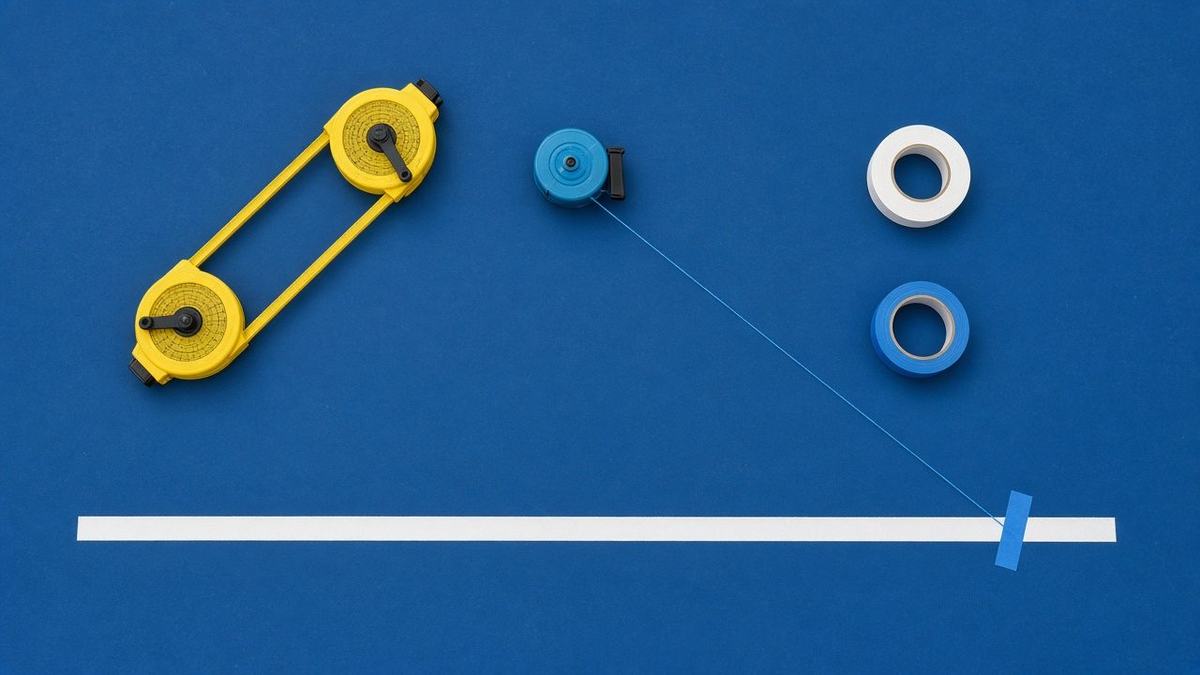
- Confirm the space. Measure the full playing surface first. The rulebook minimum is 30 by 60 feet, with 34 by 64 feet recommended. On a driveway you may have less run-off, which is fine for casual play but worth knowing.
- Mark the net line. This is the line everything else measures from. Find the center of your space and snap a line across it where the net will stand. Mark the post positions 22 feet apart, inside to inside, so each post sits about a foot outside a sideline.
- Mark one sideline and square it. Run a 44-foot line perpendicular to the net line, 22 feet on each side of it. Check that it is truly perpendicular with a 3-4-5 triangle (3 feet along the net line, 4 feet along the sideline, and the diagonal between those points should be exactly 5 feet). Larger multiples such as 6-8-10 or 12-16-20 are more accurate over a big area.
- Mark the second sideline and both baselines. The second sideline runs parallel to the first, 20 feet away measured to the outside edges. The baselines close the rectangle at each end, 22 feet from the net line.
- Check the diagonals. Measure corner to corner both ways. On a correct 20-by-44 court, both diagonals measure about 48 feet 4 inches. If they differ, the court is a parallelogram, not a rectangle. Adjust until they match.
- Mark the kitchen lines. On each side, measure 7 feet from the net line to the outside edge of the kitchen line, then run it sideline to sideline.
- Mark the centerlines. Find the midpoint of each baseline, 10 feet from either sideline, and run the centerline from the baseline to the kitchen line.
- Tape or paint. For paint, mask both edges of every line with tape so you get a clean 2-inch stripe, paint inside the measured edge, and pull the tape while the paint is still workable. Follow the paint manufacturer's directions for weather and cure time before play.
For a full home build, including surface choice, permits, and net systems, the home court guide picks up where this section ends.
When to hire a court striping contractor
Tape on a driveway is a DIY job. Permanent lines on a new or resurfaced court are often better handled by a sports surface contractor, especially when the lines are part of an acrylic coating system or when a tennis court is being converted to blended or dedicated pickleball lines.
Questions worth asking before you hire anyone:
- Dedicated 2-inch pickleball lines, or blended lines following the USTA guidance?
- Which textured line paint, and is it compatible with the existing surface?
- Does the job include crack repair or resurfacing, or only striping, and what does the warranty cover?
Compare quotes for the same scope. On public courts, this work goes through the city or parks department.
How to find courts with pickleball markings near you
If what you really want is a place to play with proper pickleball lines, you do not need to paint anything. Start with the WherePickleball court finder and browse by state or city. Our state hubs, such as Texas, California, Kansas, and city pages like Jacksonville and Dallas, list mapped courts with locations you can check before you drive.
A few practical tips:
- Satellite views often show whether a location has dedicated pickleball courts or tennis courts with blended lines. Dedicated courts look like small rectangles in a row, often several inside one fence.
- Your city's parks and recreation department usually knows which tennis courts have pickleball lines and whether portable nets are provided.
- Clubs and open-play groups know the local courts best. The clubs and leagues guide explains how to find them.
- For more search tactics, see how to find pickleball courts near you.
If you know a lined court that is not on the map, you can submit it so other players can find it.
Pickleball court lines FAQ
How wide are pickleball court lines?
Lines on a regulation pickleball court should be 2 inches wide. The USTA's guidance for blended pickleball lines on tennis courts calls for 1.5-inch lines instead.
Is the kitchen line part of the kitchen?
Yes. All lines that bound the non-volley zone are part of the zone. That is why a serve that lands on the kitchen line is a fault, and why touching the line while volleying is also a fault.
How far is the kitchen line from the net?
The kitchen line is 7 feet from the net on each side, measured to the outside edge of the line. The kitchen is 7 feet deep and 20 feet wide.
What color should pickleball lines be?
On a dedicated court, all lines should be the same color and clearly contrast with the playing surface. White is the most common choice. Blended lines on a tennis court are intentionally low-contrast, a lighter shade of the court color, so they do not distract tennis players.
Can you play pickleball on a tennis court without lines?
You can, with a portable net and temporary lines. Use painter's tape on acrylic surfaces, or ask the court owner what is allowed. Many cities have already added blended lines to some tennis courts, so it is worth checking before you bring tape.
How many pickleball courts fit on a tennis court?
With blended lines, the USTA guidance allows up to two pickleball courts on one 78-foot tennis court, one on each side of the tennis net. Converting a full tennis court area to dedicated pickleball courts can fit more, depending on the fenced area and how much run-off space you leave around each court.
Lines are the part of a court players notice least until something is wrong with them. Get the 20-by-44 rectangle square, keep the 2-inch lines inside the measured edges, put the kitchen line exactly 7 feet from the net, and the court will play the way the rulebook intends. Then go find a game on the court map.